How to write a software developer resume
Hiring teams scan developer resumes for stack fit and evidence of impact. Long lists of technologies without results blur together. Lead with what you built, at what scale and with which tools, and make it easy to verify.
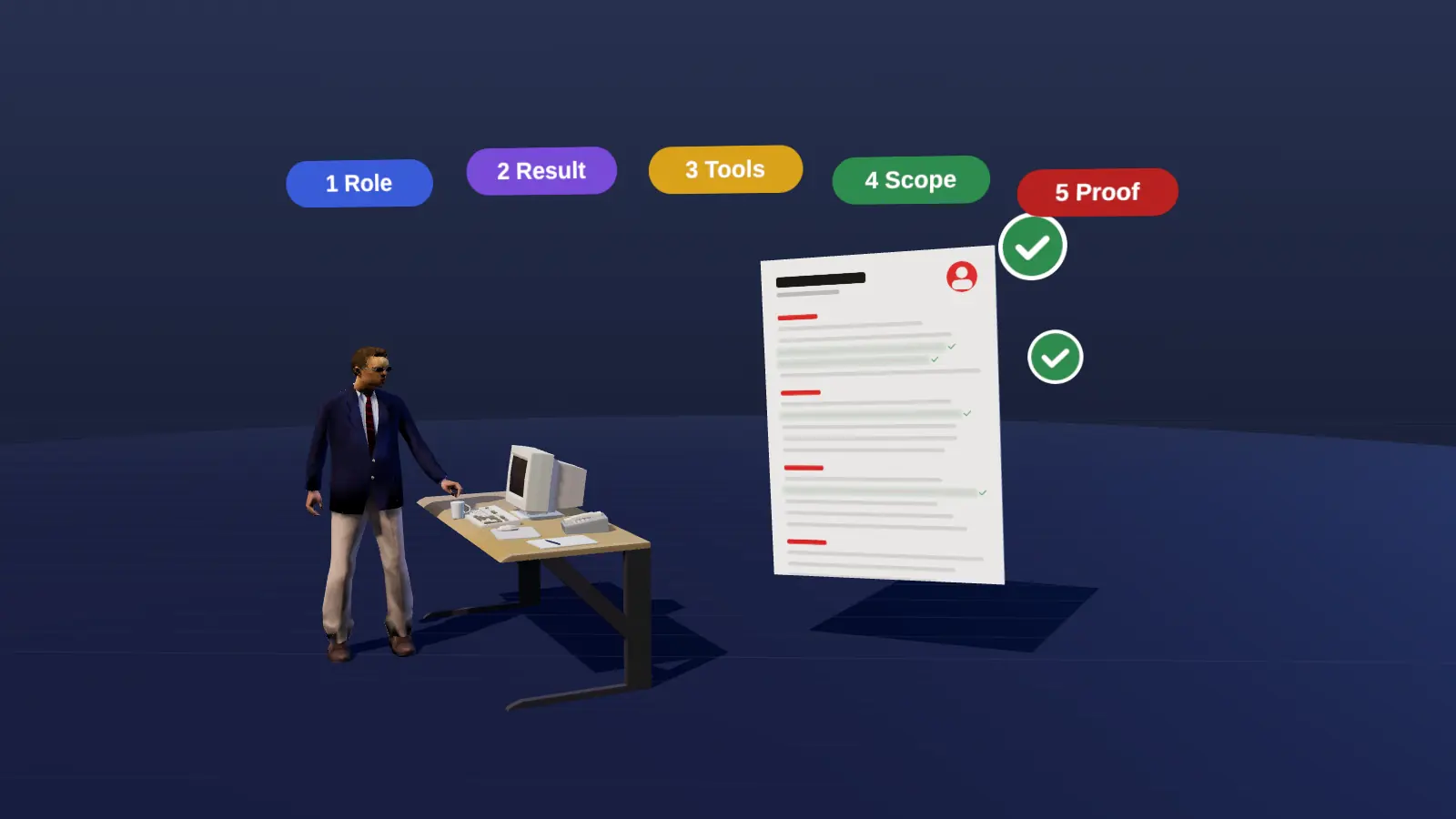
- Headline with role and main stack.
- Bullets: what you built, scale, tools, measurable result.
- Group skills (languages, frameworks, cloud, tools).
- Link to GitHub, portfolio or live projects.
Structure
| Section | Content |
|---|---|
| Headline | Backend Engineer, Go and PostgreSQL |
| Summary | Years, domain, strongest proof |
| Experience | Impact bullets with stack |
| Projects | Open source or side projects with links |
| Skills | Grouped by type |
| Education | Short |
Write impact bullets
Worked on the payments service using Java.
Rebuilt the payments service in Java and Kafka, cutting p95 latency from 800 to 180 ms and handling 3x peak load during Black Friday without incidents.
Fixed bugs and improved code quality.
Reduced flaky tests by 70% by isolating external calls, shortening CI from 25 to 11 minutes for a team of 12.
More in quantifying achievements.

Group your skills
| Group | Example |
|---|---|
| Languages | Go, Python, TypeScript |
| Frameworks | React, Django, Node.js |
| Data | PostgreSQL, Redis, Kafka |
| Cloud and tools | AWS, Docker, Kubernetes, GitHub Actions |
Put the vacancy's technologies first and only list what you can discuss. See skills section.
Paste a job link, add your resume and get a requirement-by-requirement report.
Common developer resume mistakes
- A wall of technologies with no context.
- Describing tasks instead of outcomes.
- Outdated stack at the top.
- A GitHub link with no relevant repositories.
- Two or three pages of project detail.
Sample summary
Backend engineer with six years building payment and ledger services in Go and PostgreSQL. Cut p95 latency by 78% and led the migration of 40 services to Kubernetes. Looking for a platform role with high-reliability systems.
Project bullets that hiring managers actually read
- Built an event pipeline in Go and Kafka handling 40k messages per second, cutting data lag from 20 minutes to under 30 seconds.
- Reduced p95 API latency from 900 ms to 210 ms by adding Redis caching and fixing N+1 queries.
- Migrated a monolith to three services, lowering deployment time from 45 to 8 minutes.
Each line names a technology, a scale and a measurable outcome. That is the pattern to repeat across roles.
How to present a tech stack without a keyword dump
Group skills by area: languages, frameworks, data, cloud and tools. Put the technologies named in the vacancy first, and only list what you could discuss in an interview. Show the stack in context inside bullets too, because a list of twenty logos proves little while one line showing PostgreSQL tuned for a hot table proves something real.
GitHub, portfolio and links
- Link a profile only if the top repositories are tidy and have readable README files.
- Pin two or three projects that match the role.
- For open source, name the project and your contribution type.
- Use plain URLs that survive being copied from a PDF.
Seniority signals
| Level | What to emphasise |
|---|---|
| Junior | Projects, learning speed, internships, clean code |
| Mid-level | Ownership of features, reliability, collaboration |
| Senior | Design decisions, mentoring, cross-team impact |
| Lead | Delivery, hiring, technical strategy, trade-offs |
Mistakes developers make
- Listing every library ever used.
- Describing tasks instead of impact.
- Hiding recent work below old roles.
- Including broken or empty repository links.
A final check before you send a role-specific resume
- Does the headline name the role you want, in the employer's wording?
- Do the first three lines under the latest job prove the main requirement of the vacancy?
- Is every number real, with a baseline and a time frame?
- Are tools and skills grouped, ordered by relevance and also shown inside bullets?
- Do links work and point to current work?
- Does the file open cleanly and paste into a plain text editor in a sensible order?
- Would you be comfortable explaining every line in an interview?
Read the resume once as the hiring manager, in ten seconds, and note what you remember. If that is not your strongest result, move it to the top. Then read it again as a colleague who will work with you: do the lines sound like something a real person did? Specific, honest detail beats polished vagueness every time, in every field. Keep the master version updated after each new project so tailoring stays quick.
Show verifiable work
- Link to GitHub with pinned relevant repositories.
- Describe 2 to 3 projects: problem, stack, outcome.
- Mention open source contributions with scope.
- Keep one page unless very senior.
Tailor the stack emphasis for each role (how).
Check your resume against a real vacancy
Add your resume and a job link. JobAny shows which requirements are covered, what is missing, what a recruiter sees first and whether the file reads cleanly. Start costs $1, no subscription.
Frequently asked questions
Should I list every technology?
No. List those you can discuss, prioritising the vacancy's stack.
Is a GitHub link necessary?
Helpful if it shows relevant work; skip if empty.
How long should a developer resume be?
One page up to about ten years, two for senior roles.
Do I include side projects?
Yes, especially if you are early in your career or changing stack.
How do I show impact without exact numbers?
Use scope: users, requests, team size, time saved, with honest estimates.
Should I list years per technology?
Only if the vacancy asks; otherwise show the context of use.
How do I handle bootcamp backgrounds?
Lead with projects and shipped work.
Do I include hackathons?
Yes if relevant and brief.
Should I list every technology I've touched?
No, list what you can discuss and what the vacancy asks for.
Is a one-page resume required?
One page for under ten years, two pages for more is a common guide.
Do I need a cover letter as a developer?
Optional; a short note helps for smaller companies.
Keep reading