AI resume builder vs writing it yourself
AI can save hours on the first draft, but it can also invent details or flatten your voice. Writing by hand is accurate but slow. The best approach is usually a hybrid: facts from you, wording help from AI, final review by you.
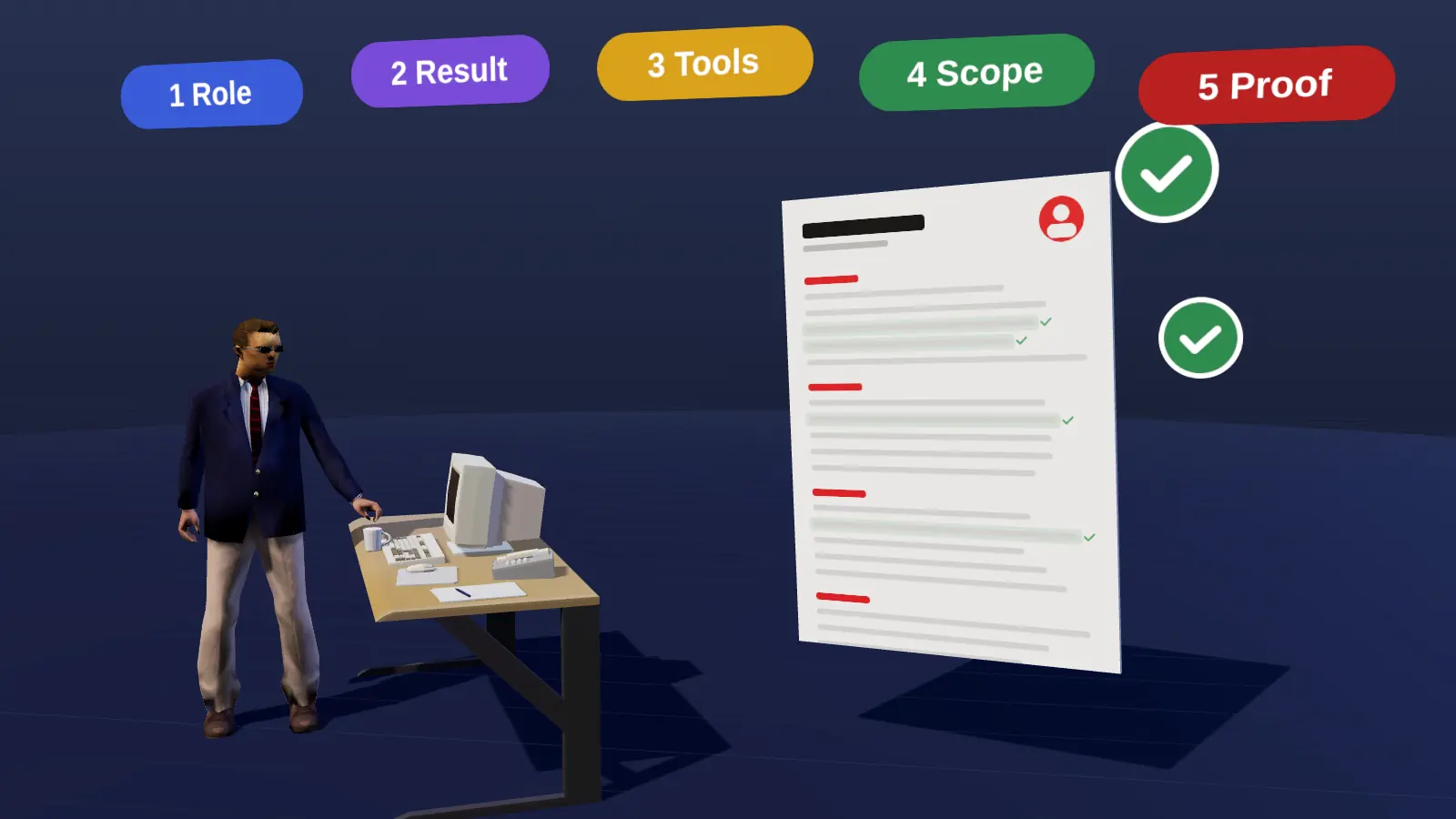
- AI is fast and good at phrasing but can invent detail.
- Writing yourself is accurate but slower and harder to structure.
- A hybrid gives speed with control.
- Always verify every claim.
Side by side
| Aspect | AI builder | Writing yourself |
|---|---|---|
| Speed | Fast first draft | Slow |
| Accuracy | Needs review; can invent | As accurate as you are |
| Voice | Can sound generic | Your own |
| Structure | Consistent | Depends on skill |
| Tailoring | Quick for each vacancy | Manual effort |
Safe way to use AI
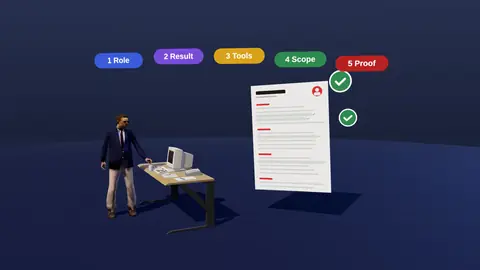
- Give it facts: role, results, tools, scope, proof.
- Ask it to phrase, not to invent.
- Check every number and tool.
- Cut generic phrases and add specifics.
- Read the final version aloud.
How JobAny approaches it
JobAny's builder interviews you with five factual questions per role and builds bullets only from your answers, then lets you tailor to vacancies. It is a hybrid by design.
Paste a job link, add your resume and get a requirement-by-requirement report.
A fact sheet to feed any AI tool
- Role, team, dates.
- Three results with numbers.
- Tools and methods used.
- Scale: users, budget, team size.
- Proof: how you measured the result.
The better your facts, the less the tool has to guess.
Red flags in AI output
- Round numbers you never gave.
- Tools you did not mention.
- Phrases like dynamic results-driven professional.
- Identical structure in every bullet.
Where writing yourself wins
- You know your story, tone and priorities better than any tool.
- Nothing unintended appears on the page.
- It forces you to recall details you might otherwise forget.
The weakness is time and blind spots: many people struggle to describe their own work in outcome terms, and formatting takes hours.
Where an assistant wins
- Speed on structure, layout and consistent formatting.
- Prompting you with questions that surface results you had not thought to mention.
- Rephrasing a weak line into a stronger one while you supply the facts.
- Tailoring one master resume to many vacancies quickly.
The weakness is the risk of generic text or invented claims if the tool writes without your input.
The hybrid approach that works
- Answer the interview questions honestly with real numbers.
- Let the builder shape those answers into bullets.
- Read every line and delete anything you cannot defend in an interview.
- Add your own voice to the summary.
- Run an analysis against a real vacancy and adjust.
This keeps the facts yours and the effort manageable.
A quick test of any generated line
For each bullet, ask: could I explain this in thirty seconds? Is there a number or concrete outcome? Does it use a verb I would naturally say? If a bullet fails, rewrite it or remove it. Recruiters often probe the lines on a resume; text you cannot talk about is a liability. See action verbs and quantifying achievements for ways to strengthen what you keep.
Privacy when using any assistant
Check where your resume is stored, who can see it and whether you can delete it. Avoid pasting government IDs or financial details into any resume tool. A resume needs contact details and work history, not sensitive documents.
A decision rule
If you are short on time or stuck, use the assistant for structure and questions. If you are confident in your writing, use it for review and tailoring. In both cases, you own the final text.
A five-question checklist before you decide
- What is my goal this month? A handful of well-matched applications needs different help from a wide search.
- How much time can I give each application? If it is under fifteen minutes, favour tools that speed up routine work.
- What is a wrong decision likely to cost? Paying blind or sending unreadable files costs more than a short trial.
- Who owns my data afterwards? Prefer tools where you can export and delete.
- Can I verify the result myself? Anything that cannot be explained should not drive your choices.
Write down your answers before comparing options, then score each against them. The best choice is rarely the one with the longest feature list; it is the one that fits the next four weeks of your search. Revisit the decision when your situation changes, for example after your first interviews or when you start targeting a new role family.
When to write it yourself
If you have a strong sense of your story and few vacancies, writing yourself with a good structure (guide) works well.
Check your resume against a real vacancy
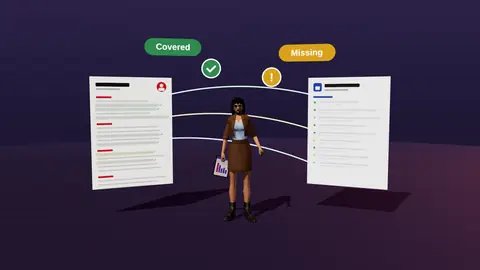
Add your resume and a job link. JobAny shows which requirements are covered, what is missing, what a recruiter sees first and whether the file reads cleanly. Start costs $1, no subscription.
Frequently asked questions
Will recruiters know it is AI?
Generic phrasing is the giveaway. Specific facts and your voice avoid that.
Can AI make up experience?
It can if prompted loosely. Provide facts and verify.
Is it cheating?
Using tools to phrase your own experience is fine; inventing is not.
Which is faster for tailoring?
AI-assisted tailoring is usually faster.
What should I always check?
Numbers, dates, tools and titles.
Should I disclose that I used AI?
Not required for phrasing your own experience, but you must stand behind every claim.
Does AI help with different languages?
It can help phrasing, but have a fluent reader check it.
What is the biggest risk?
Inaccurate or invented details that surface in interviews.
Will recruiters know a resume was AI-assisted?
They care whether it is specific and true; generic text is what stands out.
Is it cheating to use a builder?
No; it is a writing aid, as templates and spellcheckers are.
Can I mix both?
Yes, that is usually the best result.
Keep reading