Resume vs job description: how to measure your match before you apply
Before you spend an hour tailoring an application, it helps to know how close you already are. A match check answers that: for this vacancy, which requirements does your resume already prove, which does it hide and which are missing? Here is a method you can do by hand, and how to read a score honestly.
- Split the vacancy into requirements and tag each as covered, hidden or missing.
- Weigh must-haves above nice-to-haves.
- Treat any score as an estimate; the table behind it is what you act on.
- Apply when must-haves are mostly covered or learnable; skip when core ones are missing.
What a match check measures
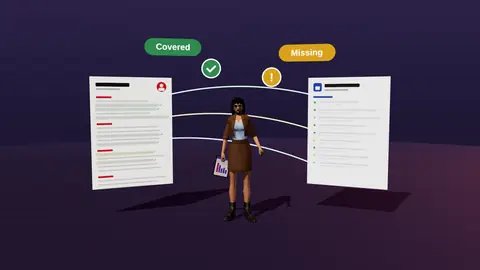
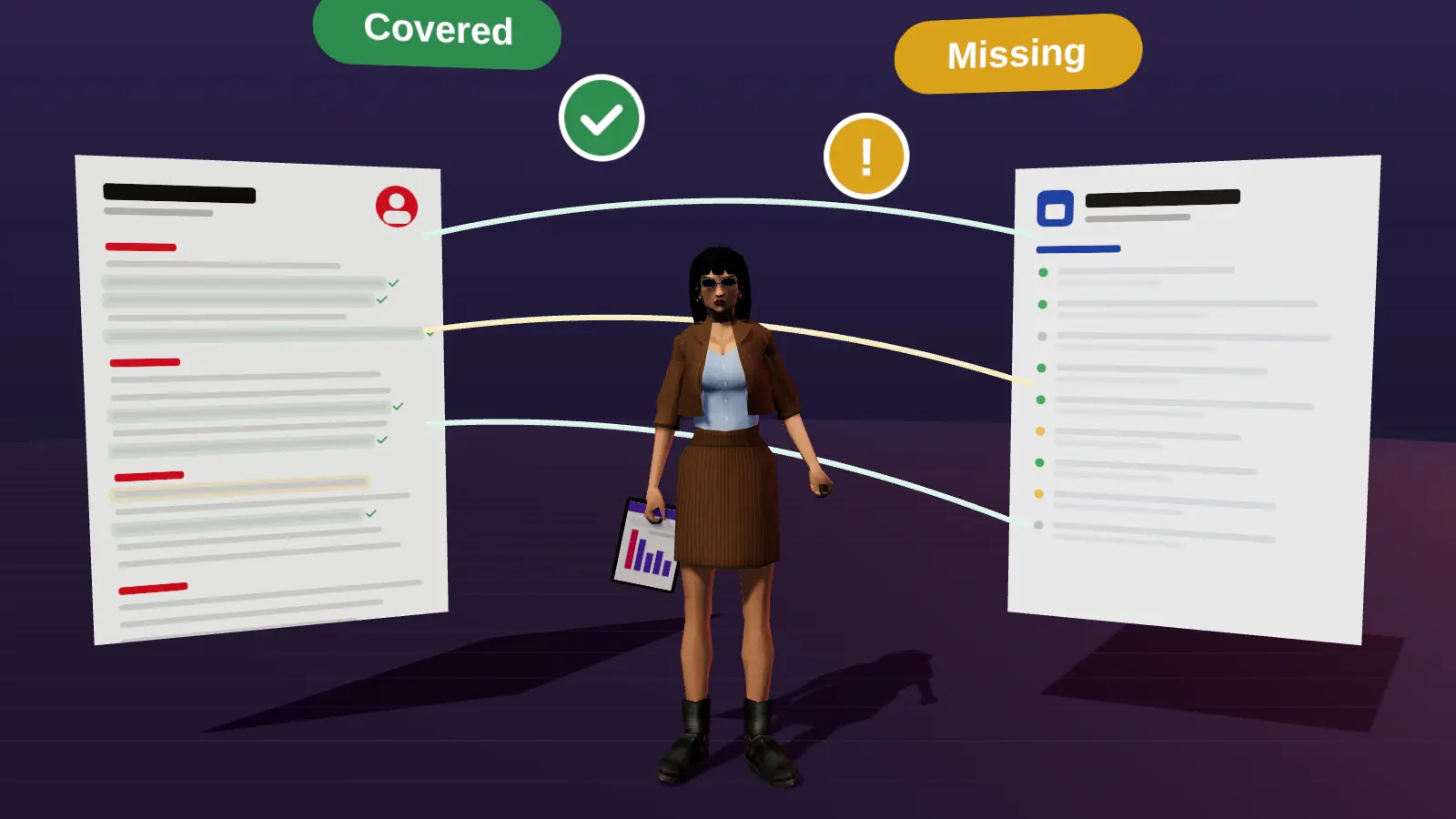
A match check compares two documents: the vacancy (what they want) and your resume (what you show). The useful output is not one number. It is a list of requirements with a status for each, so you know where to improve the resume and whether the role is realistic.
The three statuses:
| Status | Definition | Action |
|---|---|---|
| Covered | The resume shows it clearly, ideally in the top half of the page | Keep it visible |
| Hidden | You have done it, but it is missing, buried or phrased differently | Reword with the vacancy's term and move it up |
| Missing | You have no evidence | Decide whether it matters; do not claim it |
The manual method (15 minutes)
- List the vacancy's requirements, separating must-haves from nice-to-haves.
- Write beside each the strongest evidence in your resume, with the line or job it appears in.
- Tag each as covered, hidden or missing.
- Weight the result: three missing must-haves is more serious than five missing nice-to-haves.
- Decide: apply as is, tailor first or skip.
The detailed way to turn the list into a better resume is in how to tailor your resume.

Reading a score honestly
Many tools show a percentage. Treat it like a thermometer in an unfamiliar room: it tells you something, but you should know how it is measured. Ask:
- Is it based on this specific vacancy or on an abstract template?
- Does it show which requirements drive the number?
- Does it separate must-haves from filler?
- Does it count keyword repetition (bad) or evidence in context (good)?
No external score knows the employer's own weights or the recruiter's judgement. A 70% match with all must-haves covered is better than 90% that hides a missing core skill.
Do not chase 100%. Rewriting a resume to maximise a number often makes it worse for people. Aim for clear evidence on the points that matter.
Paste a job link, add your resume and get a requirement-by-requirement report.
When to apply anyway
Job postings describe an ideal candidate. Apply if:
- Most must-haves are covered and the rest are learnable or listed as preferred.
- Your hidden items can be fixed honestly by rewording.
- Your evidence of results is strong, even if the tool list differs.
- You can get a referral or a short intro to someone on the team.
Skip or deprioritise when core, hard requirements (a licence, a language, a certification, years in a specific domain) are clearly missing and cannot be offset.
A simple way to score your own match
Make a table of the vacancy's requirements, split into must-have and nice-to-have. For each, give a score: 2 if clearly shown with evidence, 1 if buried or partial, 0 if absent. Weight must-haves double. Add up and compare with the maximum.
| Requirement | Weight | Your score |
|---|---|---|
| SQL (must) | 2 | 2 shown with result |
| A/B testing (must) | 2 | 1 buried |
| Dashboards (must) | 2 | 2 |
| Python (nice) | 1 | 0 |
Here you score 10 of a possible 14: a good match, with a quick win in surfacing A/B testing.
What a good match looks like
- Most must-haves are covered with evidence.
- Seniority fits: your scope is similar to what the role describes.
- The domain or customer type is familiar.
- The missing items are learnable or nice-to-have.
What to do with the number
| Match | Action |
|---|---|
| High (about 75% or more) | Tailor and apply; add a human route |
| Medium (50 to 75%) | Apply if you can surface hidden evidence or the company is a priority |
| Low (under 50%) | Skip, or build proof first |
Why a generic percentage can mislead
An online score that does not show its reasoning cannot guide your edits, and it may reward keyword stuffing. A real match is about evidence for the requirements that matter most to this employer. Use any tool for speed, but verify the logic with the table above. See resume analysis for a vacancy and analyzer vs ATS scanner.
After the check: three quick fixes
- Move the strongest covered items to the first third of page one.
- Reword hidden items with the vacancy's terms in context.
- Add truthful context to partial matches (scale, period, outcome).
JobAny's analysis produces exactly this list for a real vacancy and shows what a recruiter sees first. See resume analysis for a vacancy.
Check your resume against a real vacancy
Add your resume and a job link. JobAny shows which requirements are covered, what is missing, what a recruiter sees first and whether the file reads cleanly. Start costs $1, no subscription.
Frequently asked questions
What is a good resume match score?
There is no universal threshold. Focus on must-haves: if the core ones are covered and the rest are reasonable, you are competitive.
Is a resume match score the same as an ATS score?
No. An ATS score, where it exists, is an employer-specific feature. A match score from a tool is an estimate against a vacancy you provide.
Can I trust AI match percentages?
Treat them as a starting point. Always read the requirement table behind the number.
Should I apply with a 50% match?
It depends on which half. Missing nice-to-haves is fine; missing the core must-haves rarely is.
How do I raise my match honestly?
Surface hidden experience in the vacancy's wording and gain missing skills through real projects or courses over time.
What is a good resume match score?
Roughly three quarters of the weighted requirements covered with evidence is a strong basis to apply.
Does a high score guarantee an interview?
No; it improves your odds only.
Should I apply with a low match?
Only if you can add real evidence or have a strong referral.
Can I raise my score honestly?
Yes, by surfacing hidden evidence and adding true results.
Keep reading