What to include in a resume (and what to leave out)
A strong resume is not about including everything; it is about including the right things in the right order. Use this checklist to decide what goes in, what is optional and what to cut.
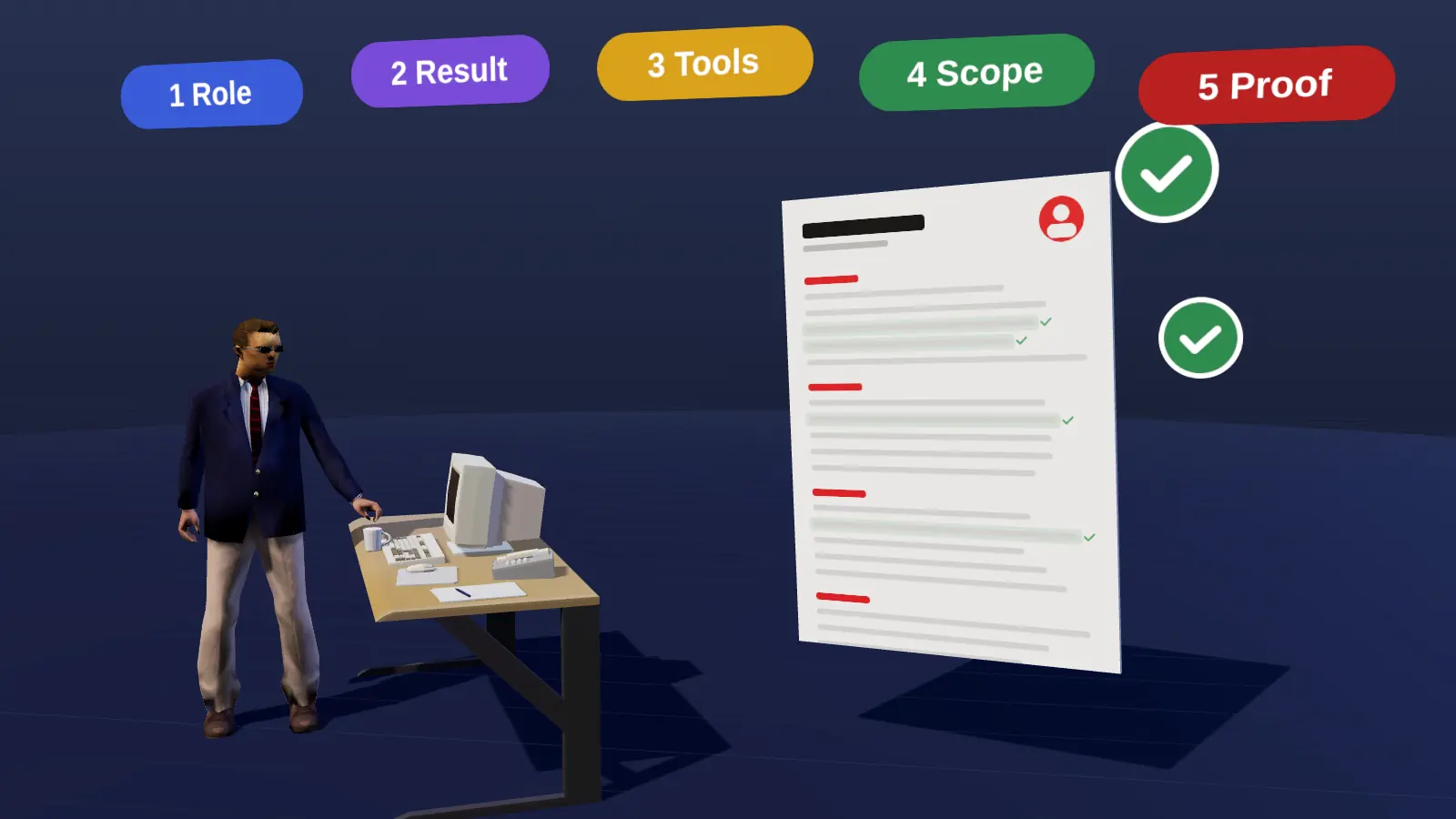
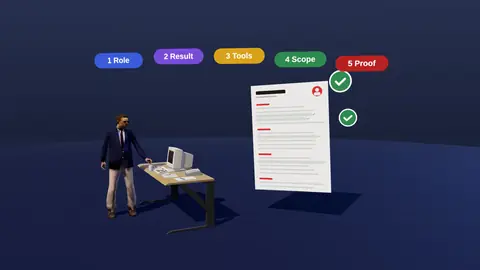
- Core: contact, headline, summary, experience, skills, education.
- Order by relevance: put the strongest evidence first.
- Optional sections only if they strengthen the case.
- Leave out photo (in US/UK), full address, age, references and irrelevant history.
The core sections, in order
| Section | What to put | Notes |
|---|---|---|
| Contact | Name, city/country, email, phone, LinkedIn | Body of the page, not header or footer |
| Headline | Target role and key strength | Mirror the vacancy title when true |
| Summary | 2 to 3 lines: role, strongest proof, fit | Examples |
| Experience | Roles in reverse order, 3 to 5 results each | Recent roles get most space |
| Skills | Grouped, the vacancy's tools first | Guide |
| Education | Degree, institution, year | Short, after experience if you have 2+ years |
Optional sections: add if they help
- Projects: key for students, career changers and developers.
- Certifications: when relevant or required.
- Languages: with levels, important for international roles.
- Publications, talks, awards: when they support the role.
- Volunteering: useful when it shows transferable skills or fills a gap.

What to leave out
| Leave out | Why |
|---|---|
| Photo (US/UK) | Not expected; adds bias risk |
| Full home address | Privacy; city is enough |
| Age, marital status | Irrelevant and unneeded |
| References | Provide on request |
| Objective statements | Replace with a targeted summary |
| Old or irrelevant jobs | Dilute the strongest evidence |
| Skill bars and ratings | Unreliable and unreadable by parsers |
| Salary history | Not needed on the resume |
Paste a job link, add your resume and get a requirement-by-requirement report.
Writing each section well
Headline: the target role plus your main strength, for example Data Analyst | SQL, Python, experimentation. Summary: two to three lines with role, strongest result and a hint of direction. Experience: for each role, title, employer, city and dates, then three to five bullets starting with a verb and ending with a result. Skills: grouped and relevant. Education: degree, institution and year, with honours only if they help. Keep sentences short and concrete.
How much space each section deserves
| Section | Share of a one-page resume |
|---|---|
| Header and summary | 15% |
| Experience | 55 to 60% |
| Skills | 10 to 15% |
| Education and other | 10 to 15% |
Give the most recent and most relevant role the most space, and compress older ones.
Special cases
- Recent graduates: education and projects first.
- Career changers: a projects or relevant-experience section before work history.
- Freelancers: group clients under one role and list outcomes.
- Returning after a break: keep a short line explaining it and focus on skills.
- Academics: publications and grants in a CV.
Final checklist
- The target role is clear in the first two lines.
- Experience shows results, not just duties.
- Skills match the vacancy and are grouped.
- Dates and titles are consistent.
- No photo, age, marital status or references line (in US/UK style).
- Exported as a text PDF.
For deeper help see how to make a resume and resume mistakes.
Next steps after reading this guide
Apply what you just read to one real resume rather than keeping it as theory. Open your current file, pick the single change from this guide that would help most, and make it today. Then check the result against a real vacancy with resume analysis and keep the improved version as your new master. If you are still deciding what to prioritise, read common resume mistakes and how to quantify achievements, which fix most weak resumes. When you are ready to send, run the readability test from ATS-friendly format, and log the application in your tracker so you remember to follow up. Small, consistent improvements beat one large rewrite: change one thing, send, observe the replies, then change the next.
Key terms explained
- ATS
- Applicant tracking system, software employers use to collect, store and search applications.
- Parsing
- The step where software reads your file and sorts the text into fields such as name, employers and dates.
- Tailoring
- Adjusting emphasis and wording of the same true facts for one specific vacancy.
- Requirement coverage
- How many of a vacancy's main requirements your resume proves with evidence.
- Master resume
- Your complete private version with every role and result, from which you build shorter tailored copies.
- Warm introduction
- A recommendation or message passed through someone who already knows both sides.
- Reply rate
- Replies divided by applications sent, the clearest signal of whether your approach works.
Knowing these terms makes it easier to read job ads, compare tools and judge advice you find online, because many claims depend on what exactly is being measured.
Check each item with a simple test
For every line ask: does this help the reader see I can do this job? If not, remove or shorten it. The test is stricter for older and less relevant roles and gentler for strong recent evidence.
- List the vacancy's top five requirements.
- Mark where each is shown on the resume.
- Strengthen those lines and remove lines that support none.
- Confirm the top third shows role, strongest result and key tools.
For a requirement-by-requirement check, see resume analysis for a vacancy.
Check your resume against a real vacancy
Add your resume and a job link. JobAny shows which requirements are covered, what is missing, what a recruiter sees first and whether the file reads cleanly. Start costs $1, no subscription.
Frequently asked questions
Should I include a summary?
Yes, if it is specific and tailored. Skip it if you would write a generic one.
Where does education go?
After experience if you have working history; before it for recent graduates.
Should I list every job?
No, only relevant ones, usually the last 10 to 15 years.
Do I include hobbies?
Only if they are relevant or distinctive in a way that helps.
Do I put my photo?
Not in the US or UK; optional in some European markets.
Should I include a headline?
Yes, a short one naming your role and key strength.
Do I need a LinkedIn link?
Yes, if the profile is current and consistent.
Should I list every job?
Only relevant ones, usually the last ten to fifteen years.
Can I include volunteering?
Yes, when relevant or filling a gap.
Keep reading