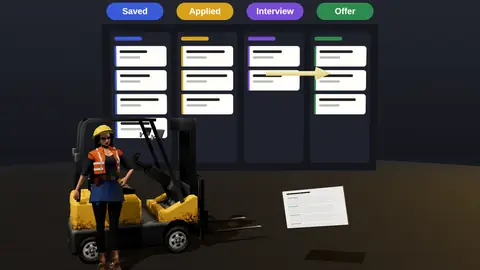
Find a warm introduction to the company you want to join
A referral or a warm introduction is among the most effective ways to get noticed. The hard part is finding who to ask and what to say. Intro Lab helps you map possible connections to a target company and draft a short message that is easy to say yes to.

- Helps map connection paths to your target company.
- Drafts a short, specific message for each contact.
- Keeps the ask easy: a referral or a brief conversation.
- Works alongside tailoring and tracking.
How it helps
- Choose a target company or vacancy.
- Identify possible paths: shared schools, past employers, communities.
- Draft a concise message that states who you are, the role and a clear, easy ask.
- Send it yourself and log the outcome in the tracker.
What a good ask looks like
Hi Marco, I saw the Product Analyst opening at Acme. I led onboarding experiments at a 300k-user app and the role looks very close. Would you be open to a 10-minute chat, or to referring me if you think it is a fit? Happy to send a short summary.
See the full playbook in how to get a job referral.

You stay in control
Messages are drafts for you to edit and send. Nothing is sent without you, and you decide whom to contact.
Paste a job link, add your resume and get a requirement-by-requirement report.
Where connections hide
| Source | Example | Message angle |
|---|---|---|
| Past employers | Former colleagues now at the target | Shared work history |
| Education | Alumni of your university | Shared school |
| Communities | Meetups, Slack groups | Shared interest |
| Open source and content | People whose work you follow | Genuine interest in their work |
Three message templates
Colleague: Hi Marco, I saw Acme is hiring a Product Analyst. We worked on the pricing project together; would you be open to a quick chat about the team?
Alumnus: Hi Elena, fellow Bologna alumnus here. I am applying to the analytics role at Acme and would value 10 minutes of your view on the team.
Stranger with a reason: Hi Paolo, I read your talk on retention experiments and I am applying for a related role at Acme. Could I ask one question about the team?
Etiquette
- Ask for a small thing first: advice or a short chat.
- Make it easy to decline.
- Do not send the same text to everyone at a company.
- Say thank you and report back.
A worked example
Goal: Product Analyst at Acme. You search your own network and find a former colleague, Marco, now on Acme's data team, and an alumna, Elena, in a nearby team. Marco gets a warm note referencing shared work; Elena gets a short alumni message asking for advice. Within a week Marco offers a referral, and the recruiter's reply arrives two days after the referral. Without the introduction the application would have joined hundreds in the queue.
Respect and boundaries
- Contact only people you can reasonably reach and who might expect to hear from you.
- Never scrape private data or pressure anyone.
- Keep messages short and make declining easy.
- Respect replies, including no reply.
Pair it with a strong application
A referral opens a door, but the resume must still match the role. Before you ask, run the analysis and tailor the file so the referrer feels confident forwarding it. A well-matched resume plus a warm introduction is the strongest combination available to a candidate.
A message template that gets replies
Open with the connection, state the ask in one sentence, show you did your homework, and make saying no easy. Example: Hi Marco, we worked together on the billing migration. I am applying for the Product Analyst role at Acme and noticed you are on the data team. Would you be open to a ten-minute chat about what the team values?
Who to approach first
- Former colleagues now at the company.
- Alumni from your school or programme.
- People who posted the role or work in the team.
- Second-degree contacts through a mutual friend.
Where this fits in the full JobAny workflow
A strong application is built in a sequence, and each step feeds the next. 1. Find roles with the job search agent or the channels in where to find jobs. 2. Read the vacancy properly using how to read a job description. 3. Analyse your resume against it with resume analysis. 4. Tailor the top of the page with resume tailoring. 5. Add a short cover note if it helps. 6. Find a warm route through warm intros. 7. Apply and log it in the tracker. 8. Follow up using follow-up methods. Skipping a step is fine when the role does not justify the effort, but knowing the sequence helps you decide where your time pays off most. Start with one role you genuinely want and run the whole path once; the second time it will take a fraction of the time.
Log everything
Record contacts, dates and replies in the application tracker so follow-ups are timely (how).
Try it on your own resume
Start costs $1 as a one-time payment, with no subscription. Add your resume and a vacancy link and see the result.
Frequently asked questions
Does it message people automatically?
No. It drafts; you send.
What if I know nobody there?
Look for alumni, communities, or the hiring team directly.
Is asking for a referral rude?
Not when polite, specific and low-pressure.
How many contacts should I try?
A few relevant ones per target company.
Does it find private data?
It helps you think through paths among people and sources you can legitimately reach.
What if nobody replies?
Try another person or send a short note to the recruiter; follow up once.
Should I attach my resume?
Offer it; attach only if asked or if the contact is a referrer.
Is it appropriate to message a stranger?
Yes when polite, specific and short.
How soon should I follow up on an intro?
After about a week, briefly.
What if the contact says no?
Thank them and move to the next path.
Does Intro Lab work for every country?
It helps you think through paths anywhere; results depend on your network.
Keep reading