How to write a CV for jobs in Italy
In Italy the document is usually called a curriculum vitae or CV. It is typically one to two pages, in Italian or English depending on the employer. Local norms differ slightly from the US and UK, so adapt without losing clarity.
- CV: one to two pages, in Italian or English as the vacancy suggests.
- Photo and personal details are optional and varying by sector.
- Privacy consent wording is commonly added to CVs for data processing.
- Check the vacancy language and match it.
Format basics
| Topic | Typical practice |
|---|---|
| Length | 1 to 2 pages |
| Language | Match the vacancy: Italian for local firms, English for international ones |
| Photo | Optional; not required |
| Personal data | Contact details; date of birth and nationality sometimes included |
| Privacy line | Often a sentence authorising processing of data under GDPR |
For general differences, see resume vs CV.
What to emphasise
- Clear job titles and employers with dates.
- Results and responsibilities in plain language.
- Language skills with CEFR levels, including Italian level.
- Education with degree and institution.
- Relevant permits or ability to work in Italy if applicable.
Finding roles
Use national job boards, company career pages, recruiters and networks. See where to find jobs. For the experience of moving from Ukraine, see resume for Ukrainians in Europe.
Paste a job link, add your resume and get a requirement-by-requirement report.
Sample privacy line
I authorise the processing of my personal data in accordance with Regulation (EU) 2016/679 (GDPR).
Check with local sources whether the employer expects a version in Italian.
Language levels
| Level | Meaning |
|---|---|
| A1-A2 | Basic |
| B1-B2 | Independent user |
| C1-C2 | Proficient |
State Italian and English levels honestly using CEFR terms.
Format conventions in Italy
- Many employers still expect a photo-free, concise CV; the Europass format is familiar but not required.
- Include date and place of birth only if it is customary for the specific employer; it is optional and not needed.
- Add the privacy consent line often seen on Italian CVs authorising data processing under the GDPR.
- Language levels use the CEFR scale (A1 to C2).
Italian or English CV
Use Italian when the vacancy is in Italian and the company is local; use English for international companies, startups or roles that list English as a working language. If unsure, mirror the language of the vacancy. Keep contact details and job titles recognisable in both languages.
Common questions for foreigners
| Topic | What to state |
|---|---|
| Right to work | Your status and permit validity if relevant |
| Italian level | CEFR level honestly |
| Education recognition | Degree and country, with an equivalent if known |
| Location | City and willingness to relocate |
Where to look
Combine international boards, company sites and Italian portals, and use local networks, universities and professional communities. Referrals work well in Italy, where personal introductions carry weight. See warm intro finder to plan outreach.
Common mistakes for Italy
- Sending an English CV to an Italian-only employer.
- Omitting the data processing consent line.
- Unclear language levels.
- Not stating relocation or permit status when relevant.
A final check before you send a role-specific resume
- Does the headline name the role you want, in the employer's wording?
- Do the first three lines under the latest job prove the main requirement of the vacancy?
- Is every number real, with a baseline and a time frame?
- Are tools and skills grouped, ordered by relevance and also shown inside bullets?
- Do links work and point to current work?
- Does the file open cleanly and paste into a plain text editor in a sensible order?
- Would you be comfortable explaining every line in an interview?
Read the resume once as the hiring manager, in ten seconds, and note what you remember. If that is not your strongest result, move it to the top. Then read it again as a colleague who will work with you: do the lines sound like something a real person did? Specific, honest detail beats polished vagueness every time, in every field. Keep the master version updated after each new project so tailoring stays quick.
Key terms explained
- ATS
- Applicant tracking system, software employers use to collect, store and search applications.
- Parsing
- The step where software reads your file and sorts the text into fields such as name, employers and dates.
- Tailoring
- Adjusting emphasis and wording of the same true facts for one specific vacancy.
- Requirement coverage
- How many of a vacancy's main requirements your resume proves with evidence.
- Master resume
- Your complete private version with every role and result, from which you build shorter tailored copies.
- Warm introduction
- A recommendation or message passed through someone who already knows both sides.
- Reply rate
- Replies divided by applications sent, the clearest signal of whether your approach works.
Knowing these terms makes it easier to read job ads, compare tools and judge advice you find online, because many claims depend on what exactly is being measured.
Keep it parseable
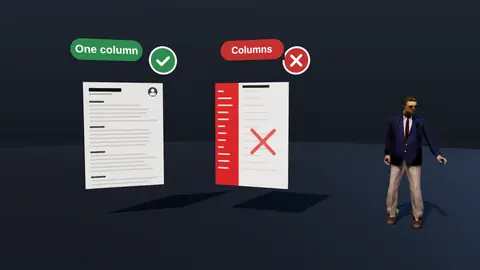
Even in Italy many companies use applicant tracking systems. Use a single-column layout (format) and tailor to the vacancy (how). Check current norms with local sources, as practice varies by sector.
Check your resume against a real vacancy
Add your resume and a job link. JobAny shows which requirements are covered, what is missing, what a recruiter sees first and whether the file reads cleanly. Start costs $1, no subscription.
Frequently asked questions
Italian or English?
Match the vacancy's language.
Do I need a photo?
It is optional; follow the employer's preference.
What is the privacy line?
A sentence authorising data processing, commonly added at the end.
Is Europass required?
No.
How long should it be?
One to two pages.
Do Italian employers read English CVs?
Many international ones do; match the vacancy language.
Do I include date of birth?
Optional and varies; many omit it.
Is the Europass format mandatory?
No.
Should I include a photo?
Usually not necessary; follow the employer's norms.
Do I need to write in Italian?
Match the vacancy language.
Is Europass required?
No, a clean CV works.
Keep reading