How to write a resume with no work experience
No job history does not mean no evidence. Projects, studies, volunteering, part-time work, clubs and self-taught skills all show you can do things. The trick is to present them as proof for the vacancy rather than apologise for what is missing.
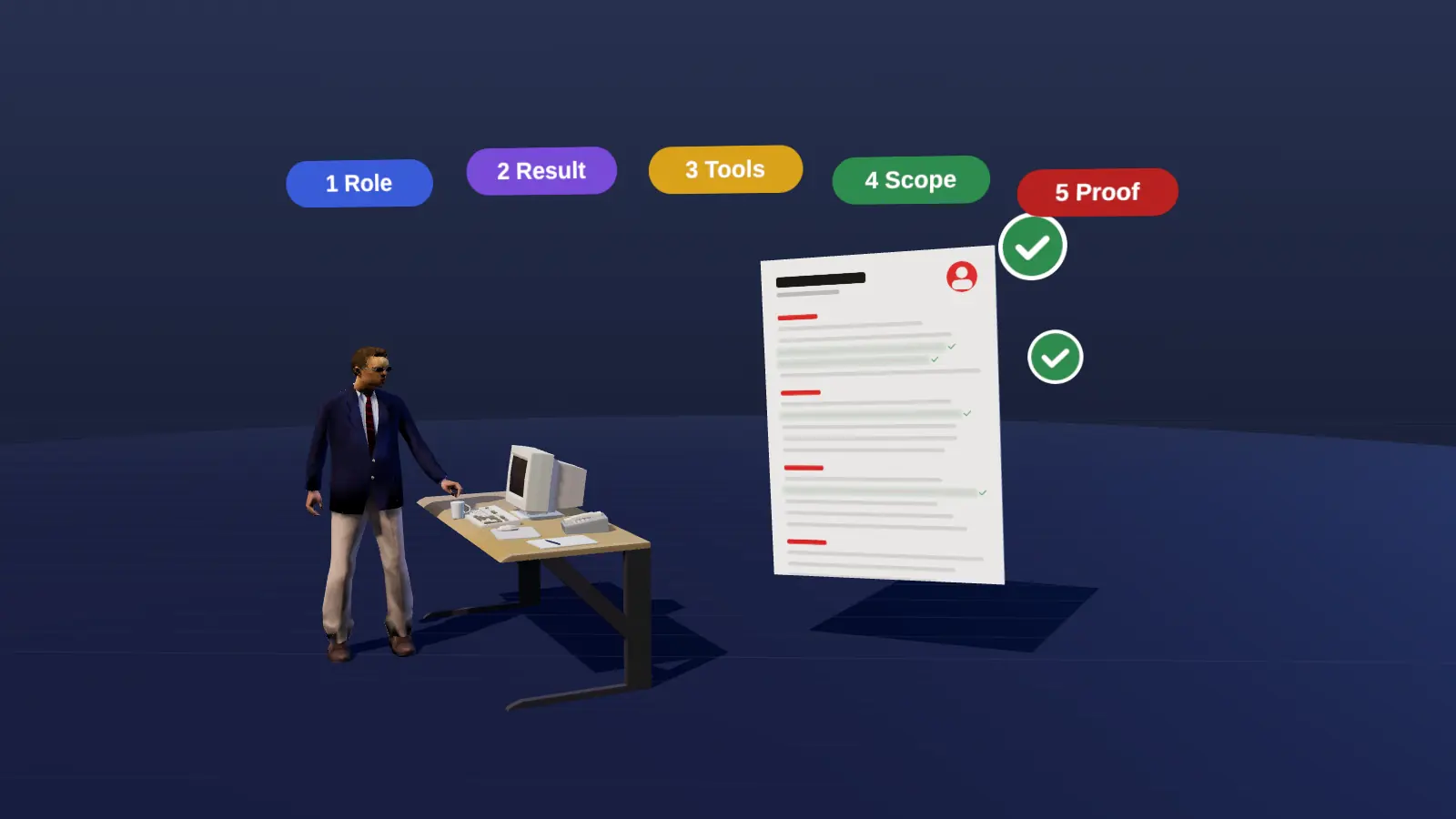
- Lead with a targeted headline and summary, then projects, then education.
- Treat projects, volunteering and part-time work as real experience.
- Show results and numbers even at small scale.
- Match the vacancy's keywords with skills you genuinely have.
Structure for a first resume
| Order | Section | Content |
|---|---|---|
| 1 | Contact and headline | Target role, e.g. Junior Data Analyst |
| 2 | Summary | Who you are, what you can do, one proof |
| 3 | Projects or relevant experience | 2 to 4 projects with results |
| 4 | Skills | Tools and methods matching the vacancy |
| 5 | Education | Degree, relevant coursework, thesis |
| 6 | Other | Volunteering, languages, certifications, activities |
Where experience comes from
- Projects: course, personal or open source; state the problem, tools and outcome.
- Part-time and seasonal work: customer, cash or team experience shows reliability and communication.
- Volunteering and clubs: organising, fundraising or leading are transferable.
- Freelance and gigs: small client work counts.
- Self-study: courses and certificates with something built afterwards.
Before and after
Participated in a university group project about marketing.
Led a 4-person course project analysing the campaigns of 5 local brands; presented findings that earned the top grade of 30/30 and a recommendation adopted by a partner shop.
Worked as a waiter.
Handled up to 60 covers per shift in a busy restaurant; trained 3 new staff and cut order errors by tracking mistakes in a shared sheet.
Paste a job link, add your resume and get a requirement-by-requirement report.
Write a summary that is specific
Recent economics graduate with Python and SQL skills. Built a rent-price dashboard used by 200 students and analysed 50k records for a thesis on local housing. Seeking a junior data analyst role where I can apply data cleaning and visualisation skills.
It states role, tools, proof and goal in three lines. See more summary examples.
Turn school, hobbies and life into evidence
- A university project becomes: problem, method, tools, result.
- A part-time job becomes: reliability, customer handling, teamwork with numbers.
- A hobby such as running a Discord community becomes community management with member counts.
- A sports captaincy becomes leadership and coordination.
The principle is the same as with any experience: show what you did and what changed, and tie it to the vacancy.
A one-page example
| Section | Sample content |
|---|---|
| Headline | Junior Marketing Assistant | Content, SEO, Analytics |
| Summary | Marketing graduate who grew a university blog to 6k monthly readers and ran a campaign for a local cafe, lifting weekday visits by 15%. |
| Projects | Blog growth project; cafe campaign; email newsletter experiment |
| Skills | SEO basics, Google Analytics, Canva, copywriting |
| Education | BA Communication, 2026 |
Where to find experience fast
- Pick a real problem for a local business or nonprofit and offer to help for free once.
- Build a small project with public data and publish it.
- Contribute to an open-source project or community.
- Take a course that ends with a graded deliverable.
- Ask for a short reference or testimonial from anyone you helped.
Be honest about level
Employers hiring for entry-level roles do not expect expertise, but they do expect honesty and willingness to learn. Describe your level accurately, show you can learn fast with an example, and mention what you are studying now. Avoid claiming skills you cannot demonstrate. See students and graduates and skills section.
Next steps after reading this guide
Apply what you just read to one real resume rather than keeping it as theory. Open your current file, pick the single change from this guide that would help most, and make it today. Then check the result against a real vacancy with resume analysis and keep the improved version as your new master. If you are still deciding what to prioritise, read common resume mistakes and how to quantify achievements, which fix most weak resumes. When you are ready to send, run the readability test from ATS-friendly format, and log the application in your tracker so you remember to follow up. Small, consistent improvements beat one large rewrite: change one thing, send, observe the replies, then change the next.
Key terms explained
- ATS
- Applicant tracking system, software employers use to collect, store and search applications.
- Parsing
- The step where software reads your file and sorts the text into fields such as name, employers and dates.
- Tailoring
- Adjusting emphasis and wording of the same true facts for one specific vacancy.
- Requirement coverage
- How many of a vacancy's main requirements your resume proves with evidence.
- Master resume
- Your complete private version with every role and result, from which you build shorter tailored copies.
- Warm introduction
- A recommendation or message passed through someone who already knows both sides.
- Reply rate
- Replies divided by applications sent, the clearest signal of whether your approach works.
Knowing these terms makes it easier to read job ads, compare tools and judge advice you find online, because many claims depend on what exactly is being measured.
Tailor it to the vacancy
Copy the vacancy's main requirements, pick those you can truthfully support and make sure they appear in the summary, projects and skills. Do not claim skills you cannot discuss. For the method, see tailoring a resume. For students and graduates in particular, see resume for students and graduates.
Check your resume against a real vacancy
Add your resume and a job link. JobAny shows which requirements are covered, what is missing, what a recruiter sees first and whether the file reads cleanly. Start costs $1, no subscription.
Frequently asked questions
Is it okay to have a one-page resume?
Yes, one page is ideal for a first resume.
Should I include high school?
Only if you have no higher education and it is relevant.
Can I list unfinished courses?
Yes, with the expected completion date, and only if relevant.
What if I have no projects?
Build one small relevant project, even over a weekend, and document it.
Should I mention lack of experience?
No. Lead with what you can do and your readiness to learn.
Can I use a functional format?
A simple chronological layout with projects first is clearer for parsers.
Should I lie to appear experienced?
No; verified claims fail in interviews.
Do internships count?
Yes.
How do I get references?
Ask teachers, supervisors or people you helped.
Keep reading