How to explain an employment gap on your resume
A gap is not a scandal. Recruiters see them all the time: caregiving, illness, relocation, study, layoffs, a business that did not work out, a long search. What matters is that you do not hide it awkwardly and that you show the shape of your story with confidence. Here is how.
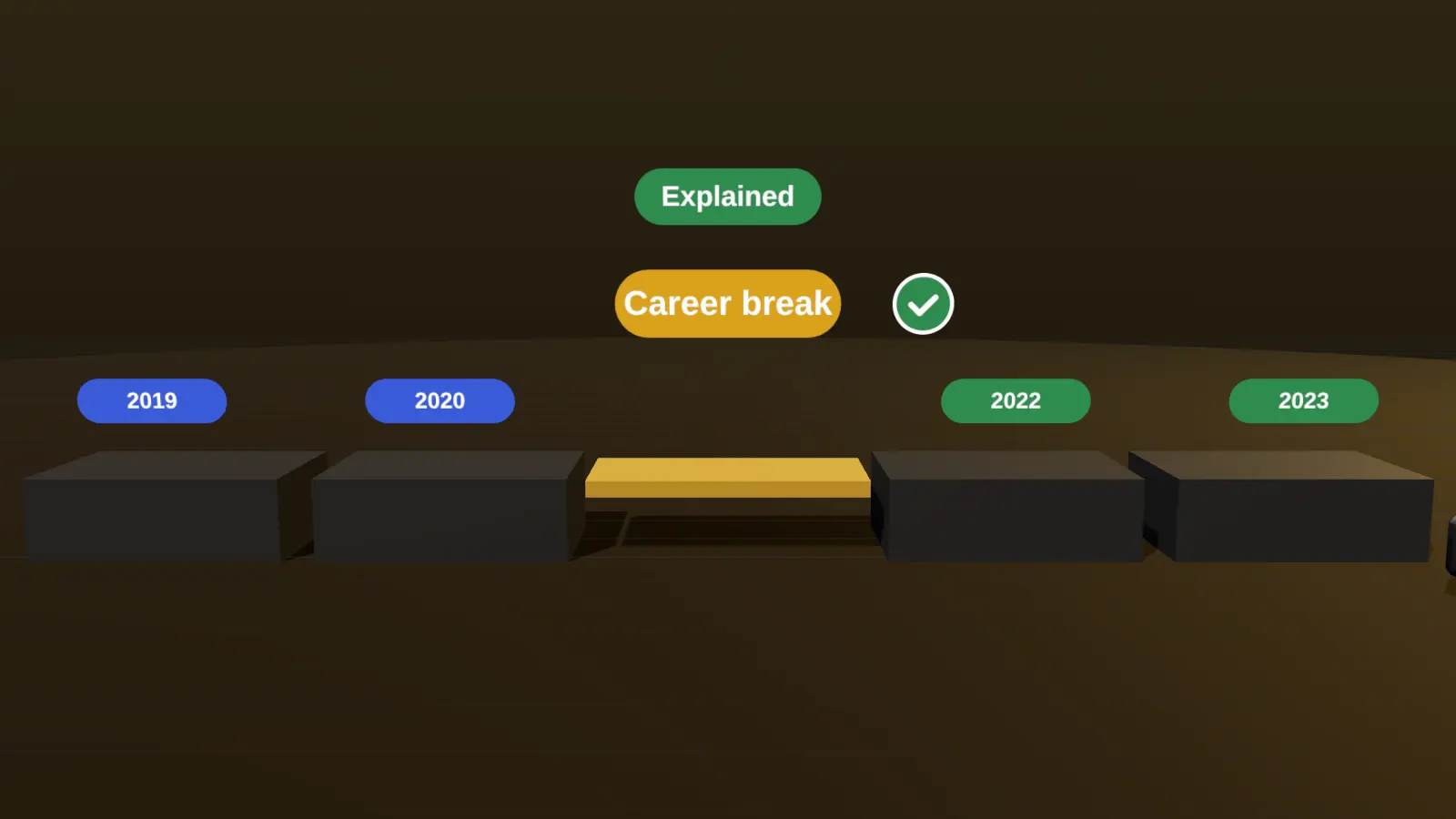
- Short gaps (under about six months) usually need no explanation.
- Longer gaps: name them briefly and neutrally, then focus on skills and readiness.
- Use years or consistent date formats; do not alter dates.
- Prepare a calm 20-second spoken answer.
What counts as a gap
A gap is a visible period between roles. Under about six months, most readers do not blink, especially if you use years only for older jobs. Longer periods raise a question to be answered rather than a flag to be feared. Your goal is to answer it briefly before the reader has to ask.
Rule 1: never falsify dates
Do not stretch job dates to hide a gap. Employers verify dates, and a mismatch is far worse than the gap.
Accurate options that are fine: using years only for roles, listing months for recent jobs, and describing the gap in a line.

Rule 2: name it in one neutral line
Add a line in the experience section as if it were a role:
(Blank space between 2021 and 2023.)
Career break: family care Mar 2021 - Aug 2023
Completed a part-time data-analytics certificate and freelance reporting projects for two small clients.
Wording options, depending on the reason:
| Reason | Resume line |
|---|---|
| Caring for family | Career break for family care; maintained skills through an online SQL course |
| Relocation or visa | Relocated to Italy; completed language studies (Italian B2) and freelance projects |
| Study or retraining | Full-time study: Data Analytics certificate |
| Layoff and search | Independent projects and courses during a role search following company restructuring |
| Health | Career break; fully available from September 2024 (no further details needed) |
| Own venture | Founder, small e-commerce shop (2022-2023); managed catalogue, ads and suppliers |
You do not need to share medical or other private detail. A short, truthful label is enough.
Paste a job link, add your resume and get a requirement-by-requirement report.
Rule 3: show you stayed current
If possible, list activity from the gap that is relevant: courses, certifications, freelance or volunteer work, open-source or portfolio projects, community work. Even small items show momentum. Place them in the relevant section, not in a long apology.
Rule 4: adjust the format if it helps
- Use years only for roles older than a couple of years if months add no value.
- Lead with a strong summary so the reader meets your skills before the dates.
- Keep the standard reverse-chronological structure; functional formats raise suspicion.
See how to make a resume for the structure and how to tailor your resume so the top third shows your match.
Gaps are common and fixable
Career breaks happen for many reasons: caring for family, health, study, relocation, a layoff, a business that did not work out, or time spent abroad. Recruiters see them often. What worries them is not the gap but an unexplained silence, so the goal is a calm, brief and factual explanation and a clear sign you are ready to work.
How to show it on the resume
| Situation | How to present |
|---|---|
| Short gap under 6 months | Use years only for roles; no explanation needed |
| Longer gap | Add a one-line entry: Career break, caring for family, 2023-2024 |
| Study or courses | List as education with the topic and result |
| Freelance or projects | List as a role with outcomes |
| Relocation or visa process | State factually, then readiness to work |
What to say in an interview
Prepare a twenty-second answer: what happened, what you did to stay current, why you are ready now. For example: I took a year to care for a family member. During that time I completed an SQL course and built a small reporting project. I'm now ready to return full time. Do not over-explain or apologise. End on the present and the role.
Stay current and show it
- Take one relevant course or certification and finish a project.
- Volunteer or freelance in your field.
- Update your LinkedIn so it matches.
- Network and ask for a warm introduction (referrals).
For moving-country gaps see resume for Ukrainians in Europe.
In the cover letter and the interview
Two sentences are enough in a cover letter: what happened, what you did and why you are ready now. In the interview, prepare a calm 20-second answer: "I took time out for family care. I kept my skills current by finishing an analytics course and freelancing. I'm now fully available, and this role is exactly the kind of work I want to return to." Stay factual, avoid over-explaining and move to what you offer.
More on preparation in preparing for an interview using your resume.
Check your resume against a real vacancy
Add your resume and a job link. JobAny shows which requirements are covered, what is missing, what a recruiter sees first and whether the file reads cleanly. Start costs $1, no subscription.
Frequently asked questions
Should I include a gap on my resume?
Short gaps usually need nothing. Longer ones are better named in one neutral line than left blank.
How long is too long a gap?
There is no cut-off. Employers care about explanation and recent relevance more than length.
Can I use years only to hide a gap?
Using years for older roles is accepted; do not alter them. Be ready to give months if asked.
Do I have to say why?
No private details are needed. A short truthful label such as career break, study or relocation is enough.
What if the gap was a layoff?
Layoffs are common and understood. State the role, move on and show what you did next.
Does an ATS penalise gaps?
ATS tools generally store dates; they do not penalise gaps. People decide.
Do I have to explain every gap?
Short gaps usually need no explanation. For longer ones a brief line helps.
Should I lie about dates?
No; keep dates accurate.
Can I use only years?
Yes, for short gaps, as long as you answer truthfully if asked.
Will a gap stop me getting hired?
Not by itself; readiness and relevance matter more.
Keep reading